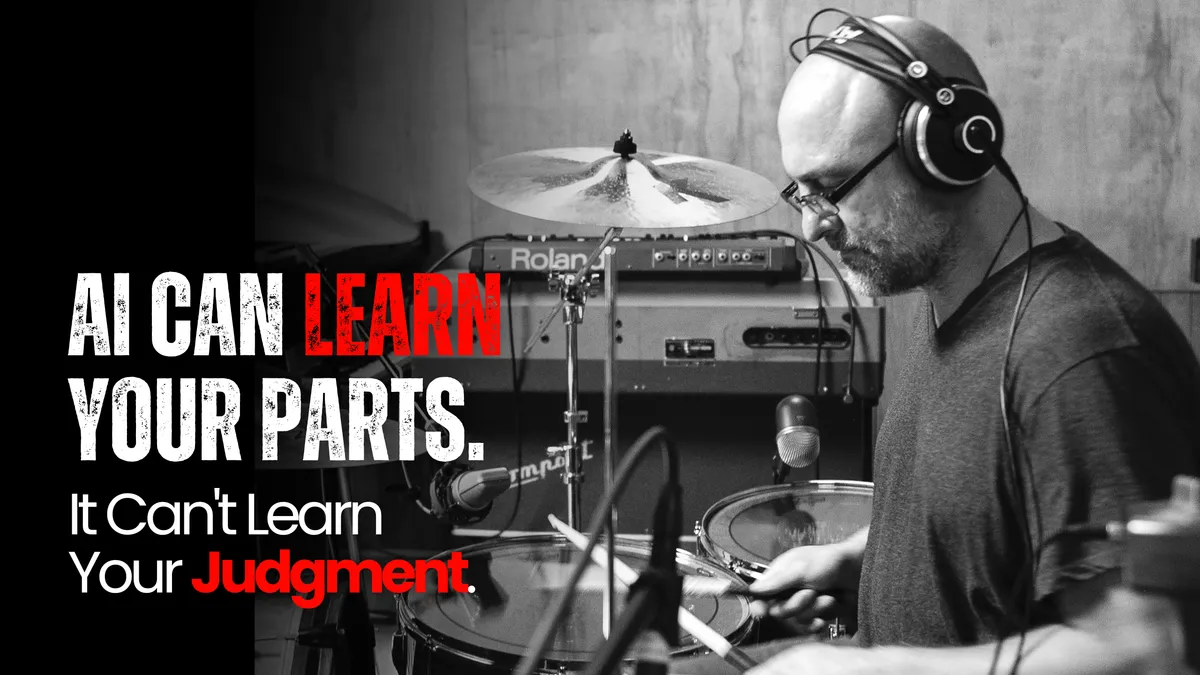
AI Can Learn Your Parts. It Can't Learn Your Judgment.
AI crossed another line.
New music tools are getting better at generating polished songs, drum parts, sounds, and arrangements. At the same time, musicians and the industry are asking harder questions about consent, compensation, and what happens when recorded performances become training material.
A drummer watching all of this might feel the ground move. If machines are getting better at the parts we can point to- the notes, patterns, sounds, and arrangements- then there is a bigger question worth asking:
What is the drummer for?
The Fear Is Not Really About Technology
Let’s name the fear plainly.
If AI can generate a convincing drum track, why would anyone hire a drummer?
If a model can produce a beat in seconds, why spend years learning time, dynamics, coordination, touch, and control?
If software can imitate a style, what happens to a player’s individual voice?
These are serious questions. They deserve more than panic. They also deserve more than the usual technology optimism.
The argument that AI will create more opportunities for everyone is too simple. Some musicians will lose work. Some sessions will be replaced. Some companies will use the tools to reduce costs. The American Federation of Musicians is not making an abstract complaint. It is asking who gets paid when recorded performances are used to train commercial systems.
That question matters. But another question belongs to the drummer.
What makes a drum part worth hearing in the first place?
The Notes Were Never the Point
A drum part can be technically correct and completely dead. It can have perfect timing, clean fills, polished sounds, and no reason to exist. You have heard this before. A track has everything in the right place, but nothing moves you. The snare lands where it should. The kick is locked. The arrangement is clean. Still, the song feels empty.
That emptiness is not a technical problem. It is a judgment problem. A drummer does more than execute instructions. A drummer decides what the song needs.
Should the snare sit directly on top of the beat, or slightly behind it?
Should the backbeat feel heavy, light, sharp, or loose?
Should the verse stay almost bare so the chorus can open up?
Should the bridge build with a tom pattern, a change in cymbal texture, or no added information at all?
Should the fill announce itself, or should it feel like the song took a breath?
Those decisions are the performance.
Technique gives you more options. Judgment tells you which option belongs.
The drummer is not a metronome with limbs. The drummer is an artist. The song comes first. Feel, space, dynamics, sound, intention, and restraint matter as much as complexity.
That is why the goal is not imitation. The goal is a musical voice.
Perfection Is Not the Same as Meaning
AI music tools are getting better at generating polished, convincing results. Recent developments across the music industry show how quickly that side of music creation is moving. That raises an increasingly important question for musicians: if execution becomes easier to generate, what becomes more valuable?
Judgment.
A drummer responds to more than a pattern. You listen to the bass player. You hear what the singer is doing. You feel when the chorus needs to open up. You notice when the arrangement is getting crowded, and you know when adding another fill would make the part worse instead of better.
A slight delay can create weight. A note arriving earlier can create urgency. Leaving the cymbal alone for a section can make its eventual entrance feel bigger. These aren’t simply notes to execute. They’re musical choices.
The important question isn’t whether technology can generate another option. It’s whether you can hear which option actually belongs in the song.
Judgment Lives in the Small Decisions
Think about a simple backbeat. Two drummers can play the same written pattern and create two different songs. One plays the snare with force but leaves the hi-hat quiet. The groove feels wide. Another plays the same snare with less weight and gives the hi-hat more presence. The groove feels nervous. Neither choice is automatically right. The right choice depends on the song. That is the work.
Judgment appears in small decisions:
Where the snare sits in relation to the bass.
How much weight the backbeat carries.
Whether the kick supports the bass line or competes with it.
When to move from hi-hat to ride.
Whether a fill should use four notes or none.
How much energy the bridge can hold before the final chorus.
What to remove when the arrangement becomes crowded.
This is the difference between execution and musicianship.
Execution asks, “Can I play this?”
Musicianship asks whether the snare should lean back, whether the kick should clear space for the bass, whether the chorus needs a wider cymbal sound, and whether the strongest fill might be no fill at all.
That question is harder. It is also where your value lives.
Your Craft Is Hiding in the Choices You Make
Here is the exercise. Take a drum part you recorded recently. It can be a full song, a rehearsal take, or a short groove on your phone. Listen once without analyzing it. Then listen again and write down your decisions.
Ask yourself:
Why did I place the snare there?
What did I choose not to play?
Where did the groove get heavier?
Where did I create space?
What did the song need at the bridge?
Did the fill help the transition or interrupt it?
Was I serving the arrangement, or showing that I could play?
Do not judge the part only by whether you made mistakes.
Listen for intention.
Listen for whether the kick supported the bass, whether the cymbal choice opened the chorus, whether the dynamics matched the vocal, and whether the space you left gave the song more shape.
That is where your craft shows up.
Do Not Compete With the Machine at Its Own Game
AI will continue to get better at generating options. More parts, more sounds, more variations, delivered faster. Musicians can use those tools where they’re useful without allowing speed or output to become the definition of musical value.
Instead, define your value by what you hear, what you remove, how you shape tension, and how you support another musician. Pay attention to how you place the backbeat, control the dynamics, voice the cymbals, and leave room for the arrangement to breathe.
Don’t compete with AI on how quickly it can generate options. Build the judgment to know which option actually belongs.
Record yourself this week and listen back. Instead of asking only, “Did I play it right?” ask one more question:
“Did I make the song better?”
That decision is part of your craft.