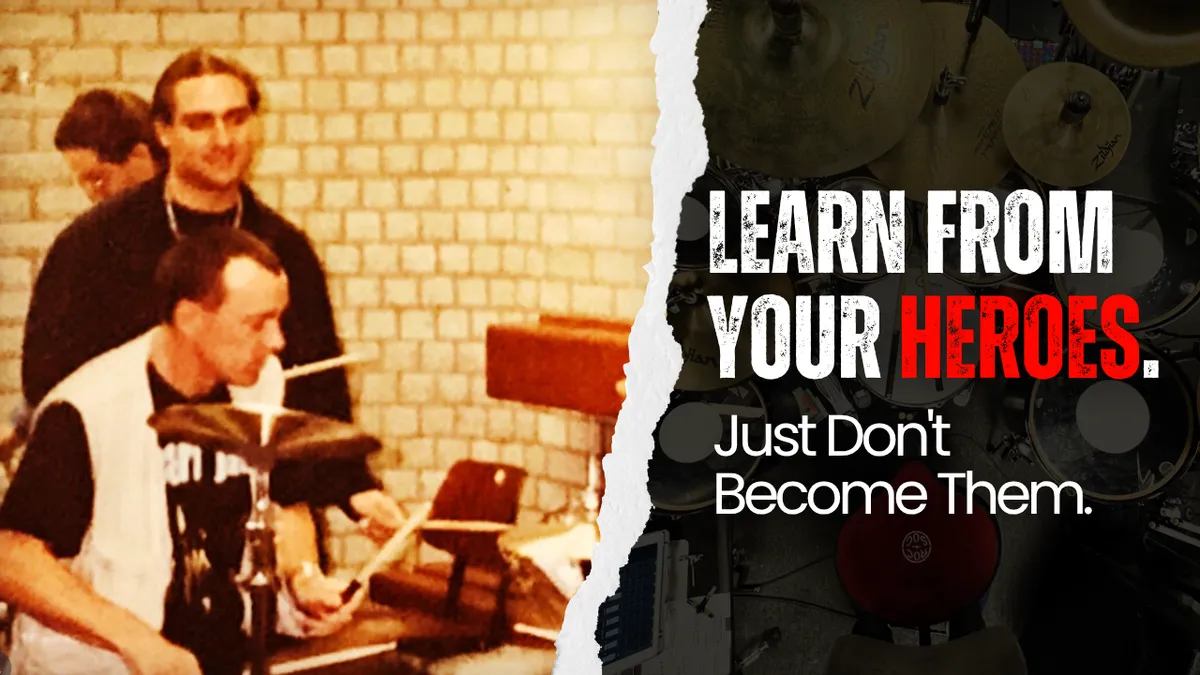
Learn From Your Heroes. Just Don't Become Them.
The new documentary about Neil Peart is called Neil Peart: No One’s Disciple, and the title does a lot of the work on its own. It points past admiration and toward a harder question about what influence is for.
How do you study a drummer deeply without becoming a copy of them?
There Is a Point Where Study Becomes Substitution
Every serious drummer should transcribe. Learn the fill, write down the sticking, find the placement, and listen for the ghost notes, the accents, the hi-hat openings, and the way the part moves through the form. That is how vocabulary develops.
The problem starts when transcription becomes the destination.
You learn every note Neil Peart played on a section of “La Villa Strangiato.” You can perform it accurately, you understand the shape of the phrase, and you know where the hands and feet go. Then you bring that vocabulary into a song that does not need it.
The verse needs restraint, but you hear a Peart fill waiting in the room. The chorus needs a simple lift, but you add a chain of orchestrated movements because you have trained yourself to hear complexity as proof of value. At that point, you are not really studying the part anymore. You are using the part to avoid making a decision.
The playing can be impressive. The notes can be correct. The result can still sound like someone else standing inside a song that belongs to you.
Influence Is What You Take In. Identity Is What You Give Back
You might study Peart’s orchestration and learn how he moved an idea across the kit. You might study his use of odd groupings, his commitment to arrangement, or his ability to make a drum part feel composed rather than improvised.
Those lessons can become part of your musical language, but your language is not the same as his.
The useful question is not, “How can I sound more like Neil Peart?”
It is, “What was Peart paying attention to that I can apply to my own music?”
A drummer who copies the surface may reproduce the vocabulary. A drummer who studies thinking starts to understand why a phrase belongs where it does.
That is where influence becomes useful. You are no longer just collecting someone else’s ideas. You are learning how to make better decisions on your own.
Peart Believed the Playing Should Keep Changing
In an archival interview included in No One’s Disciple, Peart talks about wanting to keep playing better, keep the music fresh, and keep changing. There is something important in that.
You can learn a part exactly as someone played it. You can study every detail. But the lesson does not have to end with reproducing what already exists.
Eventually, you have to decide what to do with what you learned.
Your Hero’s Vocabulary Can Still Be Wrong for the Song
Hero study becomes a problem when admiration replaces listening.
Imagine spending months learning a favorite player’s linear fills. Your hands are coordinated, the phrases are clean, and you have put serious work into them.
Now put those fills into a slow song where the vocalist needs space at the end of each line.
They may be technically excellent. They may also interrupt the lyric, crowd the transition, or pull attention away from the part of the song that actually matters.
The problem is not that the fill is too hard. It is that it answers a question nobody asked.
This is where studying your heroes can start working against you. You compare every idea you create against a finished body of work from a musician you admire.
Your own grooves start sounding too plain. Your fills feel unimportant because they do not resemble the playing you have spent years listening to.
But you are comparing your first attempts at developing a voice with someone else’s completed vocabulary.
Study should give you more choices. It should not make you distrust your own.
Respect Does Not Require Replacement
Neil Peart was part of Tim Alexander’s musical life long before Tim ever shared a stage with the music.
As a teenager, Tim would sit in his basement listening to Rush albums and trying to figure out how Neil played those parts. Decades later, he found himself performing A Farewell to Kings live, thinking about Neil and that younger version of himself still trying to understand what he was hearing.
But that influence never meant Tim felt responsible for becoming the next version of Neil. In the same interview, he talked about being self-taught and about taking inspiration from drummers like Peart, Bill Bruford, and John Bonham without trying to mimic them. What mattered was what he could learn from those players and what he could do with those ideas in his own playing.
That is where studying a hero becomes useful. You can spend years learning from someone, carry pieces of their influence with you, and still sound like yourself.
Respect does not require replacement.
Learn the Part Exactly. Then Move It Somewhere Else
Take one idea from a drummer you admire. It could be a fill, groove, orchestration, or transition. Learn it exactly. Pay attention to the notes, spacing, dynamics, and where the idea sits in the song.
Then remove it from its original context. Try it in a different arrangement. Change the tempo. Put it somewhere your hero never did. Then listen.
What still feels musical? What suddenly feels forced? What changes when the idea has to pass through your hands and your decisions? Copying is part of learning. The problem is stopping there. Transcription gives you the material. What you choose to do with it is where your own voice starts to show up.
Become the One Who Is No One’s Disciple
Learn everything you can from the people you admire. Study the parts that intimidate you. Learn the details. Pay attention to how the drummer approaches form, sound, dynamics, and time. Then bring those lessons back to your own music. Your hero already exists. Your job is not to become a smaller version of them.
Influence is what you take in. Identity is what you give back. Learn from your heroes. Then be the one who is no one’s disciple.