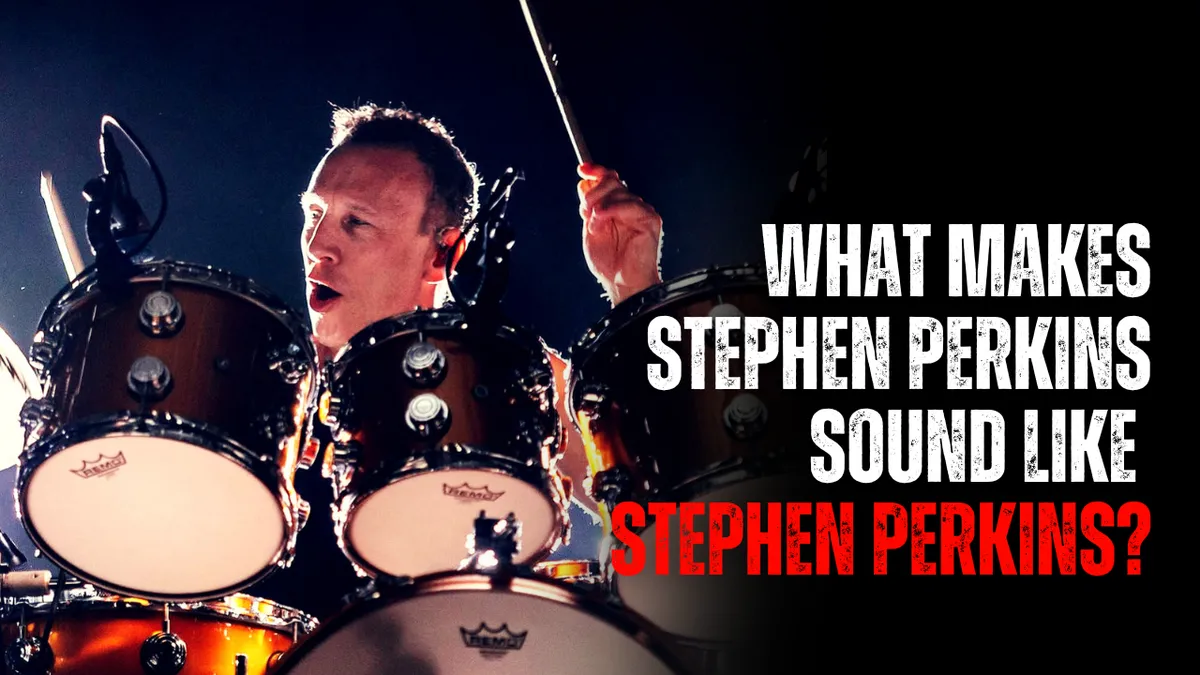
What Makes Stephen Perkins Sound Like Stephen Perkins?
Some drummers you can name inside four bars. Stephen Perkins is one of them. The interesting thing is why.
It is not one signature beat. It is not a single technique or a particular setup. A lot of what makes Perkins sound like Perkins comes from the decisions he makes about what belongs in a composition. What to add. What to leave out. What the vocal is doing. What the bass player already said. Where a groove should sit and where it should get out of the way.
That is a harder thing to copy than a lick.
The Beat Came From A Hand Drum
Take the groove on "Mountain Song." Most drummers can learn the pattern. Fewer stop and ask what kind of idea it actually is.
Perkins has said the beat works on a djembe or a conga, and it was then translated onto the drum kit. That is a different starting point from building a groove around a kick and snare grid. The pulse itself is simple enough to follow. The feel comes from the shape of the motion.
He told a story about Kenny Aronoff calling him while working up the song for a cover. Aronoff had the pattern, and something still felt wrong. "Think of it as a djembe beat, not a drum set beat."
That exchange says a lot about why learning the notes does not always give you the feel. The part is not really about sticking. It is about understanding the physical logic behind the rhythm and keeping that logic alive once it moves to a kit. A drummer who learns the transcription and misses the origin can play all the right notes and still land in the wrong place.
He Changed The Kit To Change The Music
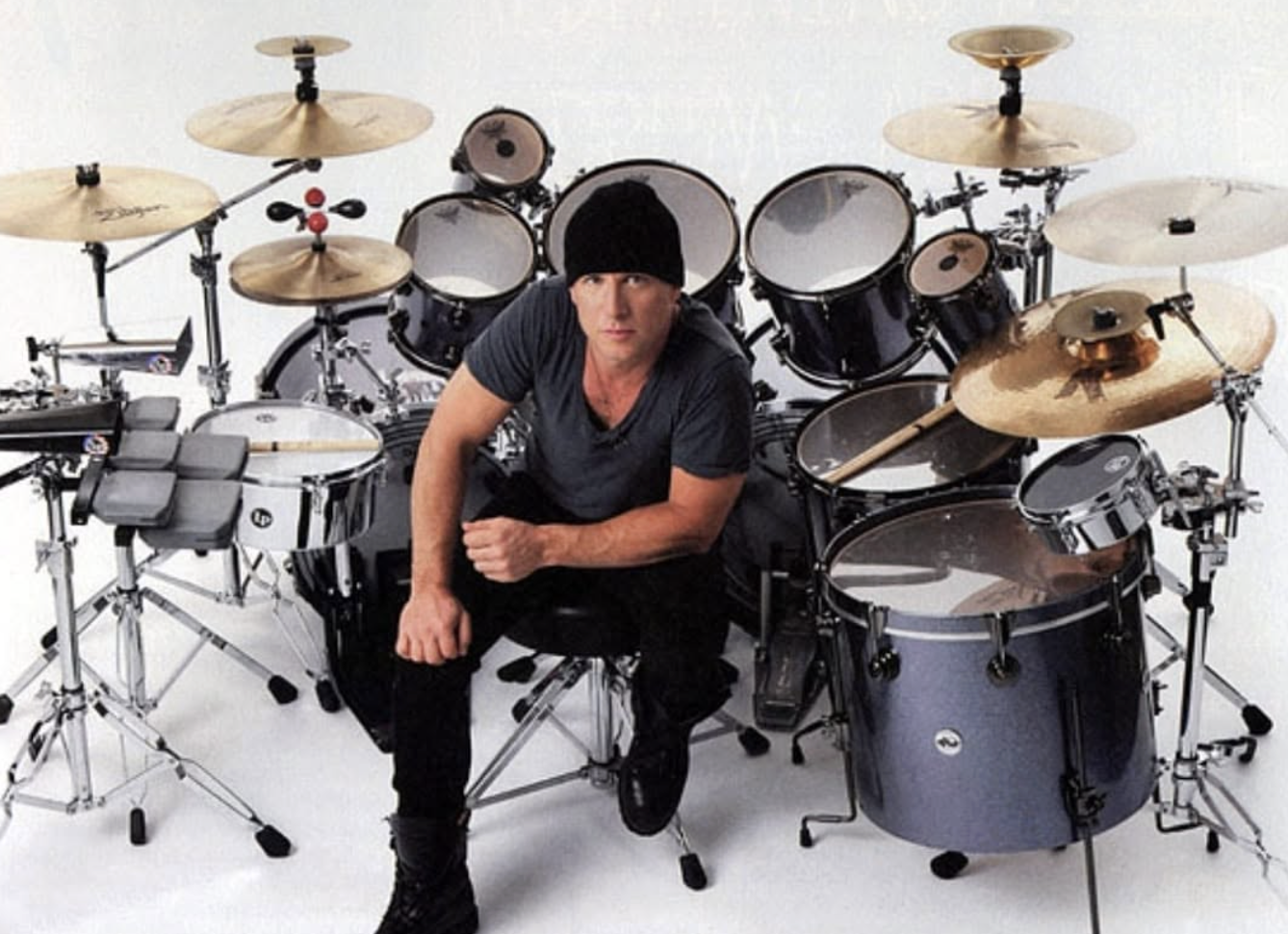
Perkins has never treated the drum kit as a fixed object. He keeps changing what is in front of him, and the changes are musical decisions rather than gear decisions.
During his time with Jane's Addiction, Perkins began experimenting with smaller drum sizes, which shifted the available intervals and made melodic movement easier to hear. With Porno for Pyros he went much further. He added a timbale and bongos, put a timbale where a floor tom would normally sit, and wanted to play live the timpani parts he had been recording. That led to a pedal built so his left foot could work the timpani.
His stated reason was simple. "I wanted to add color and be more lyrical." Not louder, not busier. More lyrical.
He has also talked about this in terms of space in the mix. He described it as a question of what part of the mix you want to draw attention to for the listener, and compared it to a film where the dialogue, the score, and the effects each need their own place. A different instrument occupies a different band of attention, which changes what the groove is pointing at. Adding a timbale is not decoration. It changes the composition.
Then there is the opposite move. With Porno for Pyros he also took things away. He stripped the standard kit back and brought in bongos, chimes, and instruments that were percussion rather than drum set, which opened up room for pocket and feel. Removing parts created a new set of decisions, and a smaller setup may leave fewer places to hide.
The Vocal Was Part Of The Arrangement
For Perkins, the vocal wasn't something that simply happened over the groove. It was part of the composition.
Perry Farrell's writing was not built on repeated chorus lines. The phrases moved, the syllable placement kept shifting, and the music had to sit with that movement rather than underneath it. Perkins has described taking his cues from what the vocal was doing, letting the lyric shape how he played instead of holding one steady pattern regardless of what was happening above it.
That is why his grooves can feel responsive without sounding loose. He was not counting bars and dropping fills into preset slots. He was listening to where the words landed and adjusting.
Finding His Place Without Interrupting
Perkins has a clear way of describing his job in a band. He is looking for the small spaces, and he is trying to find his hook among the other hooks already in the song, the bass line, the guitar riff, and the poem.
That is a specific discipline. It means knowing what the bass player owns and not competing with it. It means understanding that the guitar riff may already be the hook and that a drum part does not need to add a second one. It means playing something that makes the whole thing feel better rather than something that draws attention to the drummer.
He has put it plainly. "With rhythm, it's not what you do, it's what you don't do. It really has to be a feel."
That may be one of the easiest parts of his playing to overlook, and one of the most important.
The Part You Cannot Hear On The Recording
Here is the trap in a question like this one. The answer is not a set of moves you can lift.
You can learn every note on "Mountain Song" and still miss what makes it work. What transfers is the habit of asking why a part is shaped the way it is. Was this groove borrowed from a hand drum? Does this section need percussion or does it need silence? Is the vocal leaving space the drums should stay out of? Does the arrangement already have a hook, and if it does, what is the drum part actually there to do? Those questions are portable. The licks are not.
You can learn Stephen's parts from a recording. What you cannot hear on the recording is why he chose them.
That is where the Composition Lab begins on November 7.
Tim Alexander sits down with Stephen Perkins for a live conversation about the choices behind the playing: composition, groove, feel, dynamics, space, and instinct.
This isn’t about learning how to sound like Stephen. It’s about hearing how two unmistakable drummers think when they build a part.
If reading this sent you back to these records to listen differently, that is the same instinct the Lab is built to feed. Tickets are on sale now. Join Tim and Stephen live, ask your questions, and be in the room for the thinking behind the playing.