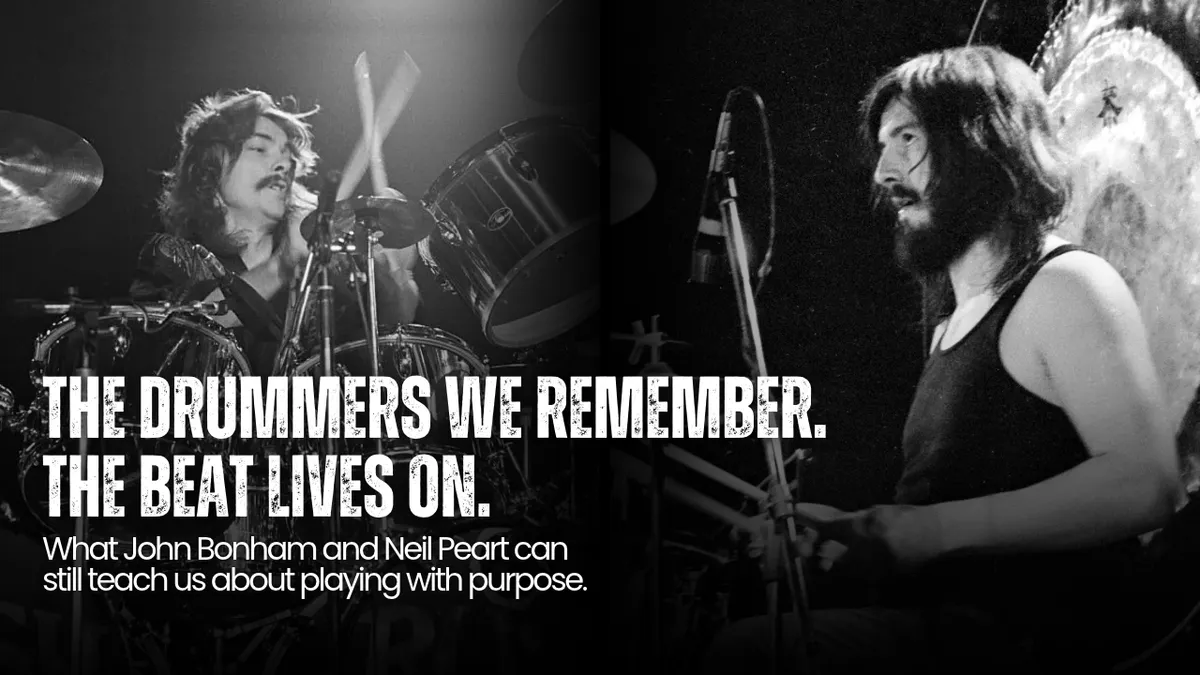
The Drummers We Remember. The Beat Lives On.
You may have heard this drum beat without realizing where it came from. It was recorded in 1971, in the entrance hall of an old stone house in the English countryside. It opens Led Zeppelin's When the Levee Breaks, and it shows up again in the Beastie Boys' Rhymin & Stealin, Dr. Dre's Lyrical Gangbang, and Massive Attack's Man Next Door.
John Bonham played it. Decades after his passing in 1980, his playing continues to reach new generations of musicians. The same goes for Neil Peart, whose influence continues through the Rush songs that drummers still study today. And if you listen closely to how they approached their playing, you'll find things you can learn from.
John Bonham: The Power of Playing Less
The sound itself came from an experiment at Headley Grange, the old stone house where Led Zeppelin recorded. Engineer Andy Johns set up Bonham's drum kit in the entrance hall, placed microphones above it near the stairwell, and used a Binson Echorec delay to shape the result. The huge, roomy sound came out of that combination: Bonham's feel behind the kit, the stairwell's acoustics, and the production choices on top. (Roland; Financial Times)
That recording went on to be sampled more than a hundred times, by everyone from the Beastie Boys to Beyoncé. (Stereogum) Producers keep reaching for it because the performance underneath holds up: a slow, deliberate groove with nothing wasted in it.
And what made his playing worth sampling was not just the sound. Listen to When the Levee Breaks or Kashmir and notice how little he actually plays. The groove feels powerful partly because he gives each note room to breathe. He doesn't feel the need to fill every gap, and the weight of each note lands harder because the ones around it are not crowded. That is a choice every drummer can study: not what he played, but where he left the space alone.
Neil Peart: Make Every Fill Count
Peart approached the instrument as a composer. His fills often felt like part of the arrangement, helping move the song from one section to another. Rolling Stone described his fills as indelible mini compositions and called him a formative influence on countless young players. (Rolling Stone)
What is worth studying is how his fills arrive. On Tom Sawyer, they do not interrupt the song. They extend it. Each one has a job, moving the music into its next section, and once the job is done he returns to the groove instead of lingering. That's what it means to think like a composer behind the kit: knowing when a fill adds something to the song instead of playing one just because you can.
Tim Alexander has spoken about spending his teenage years in a basement listening to Rush albums and trying to figure out how to play them, and about how much Peart's playing shaped his own. (Highway 81 Revisited)
In 2026, Geddy Lee and Alex Lifeson returned to the stage for Rush's Fifty Something tour, celebrating the band's music and honoring Neil Peart. (Rush; The Guardian)
The music is still being played, and the thinking behind it is still being passed on.
What Makes a Drummer Unforgettable?
Think about the drummers you can recognize within the first few seconds of a song.
It's not always their speed or the complexity of their fills. Sometimes it's their feel, the way they approach a groove, or the choices they make that nobody else would make quite the same way.
Bonham and Peart sounded different, but both developed a style that became unmistakably theirs.
And that's something worth thinking about as a drummer. Their approach to music continues to influence how drummers listen, practice, and create something of their own.
The Beat Lives On
Bonham and Peart left behind more than recordings. Their approach to music continues to influence how drummers listen, practice, and create something of their own.
On December 5, Tim “Herb” Alexander will be joined by Stephen Perkins of Jane's Addiction for a live Composition Lab. They'll explore rhythm, composition, and the creative choices that shape a drummer's playing.
Curious how experienced drummers approach rhythm and composition? Explore the Stephen Perkins Composition Lab.
So here's a question for you: Which drummer has had the biggest impact on your playing?